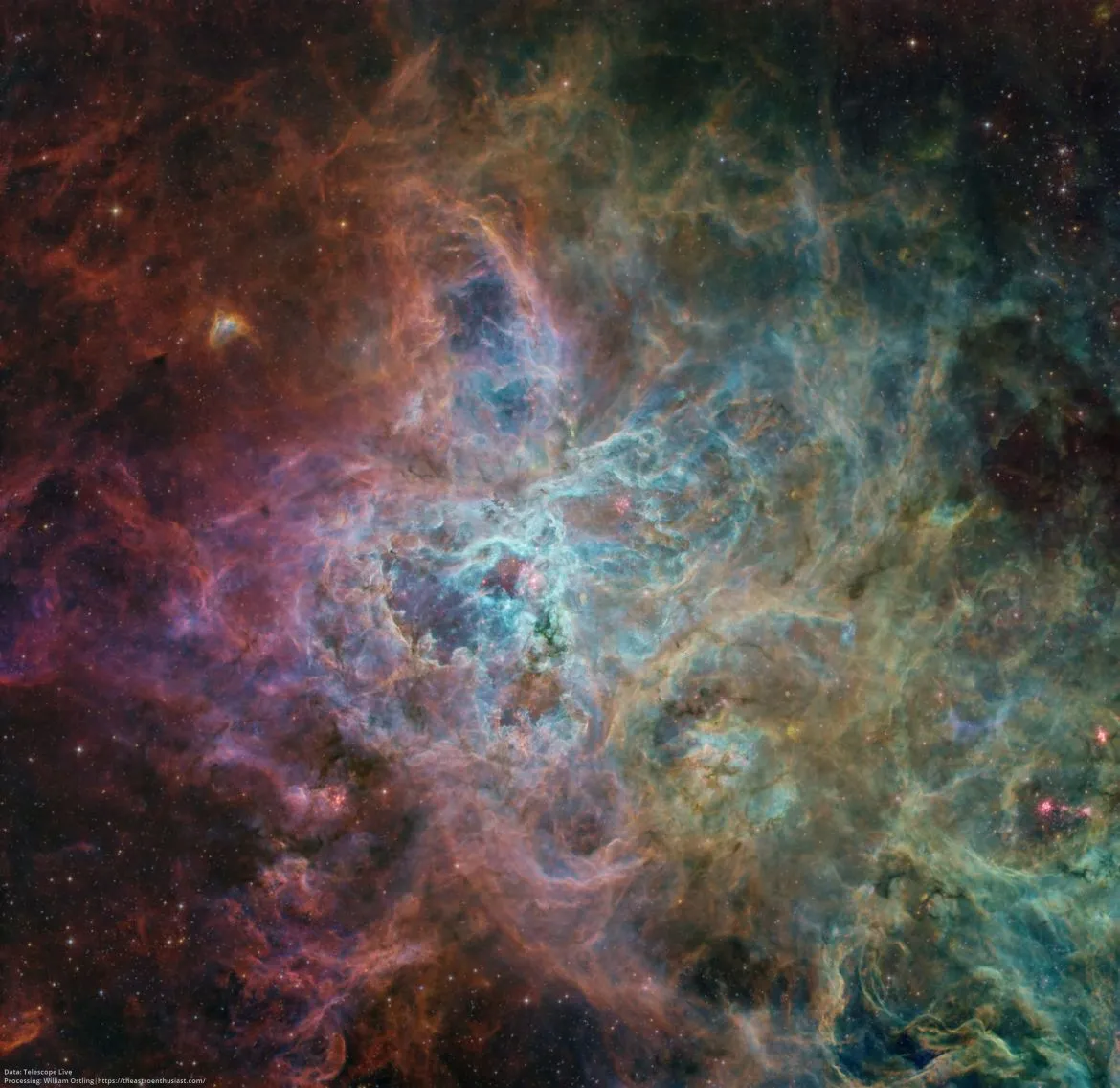
What is the Tarantula Nebula?
The Tarantula Nebula, also known as 30 Doradus, is a vast and vibrant star-forming region located in the Large Magellanic Cloud (LMC), a satellite galaxy of the Milky Way. This enormous nebula is one of the largest and most active star-forming regions in our local galactic neighborhood. It is a cosmic marvel, filled with young, massive stars, glowing gas, and dark, swirling dust clouds. The Tarantula Nebula’s dramatic appearance and intense star formation make it a prime target for astronomers studying the processes of stellar birth and evolution. Its intricate structure and energetic activity offer a unique opportunity to understand how massive stars shape their environment and influence the evolution of galaxies.
Location and Visibility
The Tarantula Nebula resides within the Large Magellanic Cloud, which is approximately 160,000 light-years away from Earth. Due to its immense size and luminosity, the Tarantula Nebula is easily visible through binoculars or small telescopes, and under very dark skies, it can even be spotted with the naked eye. Its location in the southern constellation Dorado makes it a prominent feature in the southern hemisphere’s night sky. This accessibility allows both professional astronomers and amateur stargazers to observe and study this fascinating celestial object, furthering our understanding of star formation and galactic dynamics.
Distance from Earth

The Tarantula Nebula is located approximately 160,000 light-years away from Earth, within the Large Magellanic Cloud (LMC). This distance provides astronomers with a unique opportunity to study a star-forming region that is relatively close compared to other similar nebulae found in more distant galaxies. The relatively short distance allows for more detailed observations and a better understanding of the processes occurring within the nebula. Accurate distance measurements are crucial for determining the physical properties of the stars and gas clouds within the Tarantula Nebula, allowing astronomers to calculate their sizes, masses, and luminosities more precisely. Understanding the distance also helps contextualize the nebula’s contribution to the evolution of the LMC.
Early Observations and Initial Discovery
The Tarantula Nebula’s story begins with early observations by astronomers who were charting the southern skies. Its discovery and recognition as a distinct celestial object were crucial steps in understanding its nature. Early telescopic observations played a pivotal role in revealing its unique characteristics. These observations, coupled with the identification of its nebular nature, paved the way for further investigations and a deeper understanding of this fascinating cosmic structure.
Early Telescopic Observations
Early telescopic observations were essential in the initial mapping and cataloging of the Tarantula Nebula. Astronomers using early telescopes, though limited by technology, were able to discern its nebulous appearance and its position within the Large Magellanic Cloud. These early observations, often recorded in astronomical catalogs, helped to establish its presence as a unique and significant celestial object. These observations laid the foundation for subsequent detailed studies, as astronomers sought to understand its physical properties, composition, and the processes driving its activity. The initial telescopic observations provided the first glimpse of the Tarantula Nebula’s vastness and complexity, setting the stage for future exploration.
Identifying it as a Nebula

Identifying the Tarantula Nebula as a nebula, rather than a simple cluster of stars, was a crucial step in understanding its true nature. This identification came through observations of its diffuse, glowing appearance, indicative of ionized gas and dust. Spectroscopic analysis, which examines the light emitted by celestial objects, confirmed the presence of hydrogen and other elements, typical of nebulae. This recognition helped astronomers understand that the Tarantula Nebula was a region of active star formation, where stars were being born from collapsing clouds of gas and dust. The initial identification of the nebula provided context for further studies into the process of star formation and evolution.
Key Discoveries and Studies
Numerous key discoveries and studies have greatly enhanced our understanding of the Tarantula Nebula. These investigations have shed light on the dynamics of star formation within the nebula. These discoveries include the processes that drive the formation of stars. The research on the R136 cluster provided a deep insight into the complex workings of this celestial marvel. The study has given us a clearer picture of the nebula’s composition, the formation of its stars, and its role in the evolution of its host galaxy.
Formation of Stars
The Tarantula Nebula is a hotbed of star formation, offering astronomers a unique opportunity to study the processes involved in stellar birth. Observations reveal numerous young stars, many of which are massive and hot, illuminating the surrounding gas and dust. The nebula’s structure provides insights into the mechanics of star formation, from the initial collapse of molecular clouds to the ignition of nuclear fusion in the stellar cores. Studying the Tarantula Nebula helps astronomers understand the conditions required for stars to form, the role of feedback mechanisms (such as stellar winds and radiation), and the influence of massive stars on their environment. The intense star formation occurring within the nebula provides invaluable insights into how stars like our Sun are born.
The presence of the R136 cluster

A key discovery related to the Tarantula Nebula is the presence of the R136 cluster, a dense concentration of massive, young stars at the heart of the nebula. This stellar cluster is responsible for much of the nebula’s luminosity and energetic activity. The stars within R136, some of the most massive and luminous known, emit intense radiation and stellar winds, which sculpt the surrounding gas and dust. The study of R136 provides valuable insights into the formation and evolution of massive stars and their impact on their surroundings. The cluster’s existence is a testament to the intense star-forming environment within the Tarantula Nebula, offering a unique opportunity to study the processes that govern stellar birth and evolution.
The Nebula’s Size and Scale
The Tarantula Nebula is a giant of cosmic proportions, spanning hundreds of light-years. Its immense size is a striking feature, emphasizing its significance as one of the largest star-forming regions in our local galactic neighborhood. The vastness of the nebula provides a large canvas for star formation, with numerous young stars and stellar clusters scattered throughout its structure. Understanding the scale of the Tarantula Nebula is essential for appreciating its role in the evolution of the LMC and its impact on the surrounding interstellar medium. The sheer size of the nebula underscores its potential for continued star formation and the creation of massive stars.
Comparing it to Other Nebulae
When compared to other nebulae, the Tarantula Nebula stands out for its size, activity, and the presence of extremely massive stars. Unlike smaller, less active nebulae, the Tarantula Nebula boasts an exceptional rate of star formation and a rich population of young, massive stars. The Orion Nebula, a well-known star-forming region in our own Milky Way, is smaller and less active compared to the Tarantula Nebula. The difference highlights the diversity of star-forming environments in the universe and provides valuable insights into the factors that influence stellar birth. By comparing the Tarantula Nebula with other nebulae, astronomers can better understand the diverse conditions and processes that shape these cosmic structures.
Its Significance in Astronomy

The Tarantula Nebula holds significant importance in astronomy, serving as a laboratory for studying star formation, stellar evolution, and the impact of massive stars on their environment. It provides a unique opportunity to observe and understand the processes involved in the birth of stars, from the collapse of molecular clouds to the formation of stellar systems. Its proximity and high level of activity make it an ideal target for detailed observations with advanced telescopes. Moreover, the nebula offers insights into the formation of massive stars and their effect on the interstellar medium, influencing the evolution of galaxies.
Future Research and Exploration
Future research and exploration of the Tarantula Nebula promise to reveal even more about its secrets. The next generation of telescopes, such as the James Webb Space Telescope, are providing unprecedented views of this cosmic region, allowing astronomers to peer through dust clouds and observe the formation of stars in greater detail. Advanced observational techniques, coupled with theoretical modeling, will help unravel the complex interplay of physical processes within the nebula. These efforts aim to refine our understanding of stellar birth, the evolution of massive stars, and their influence on the surrounding environment. The Tarantula Nebula will continue to be a prime target for astronomical study, offering new insights into the wonders of the universe.